

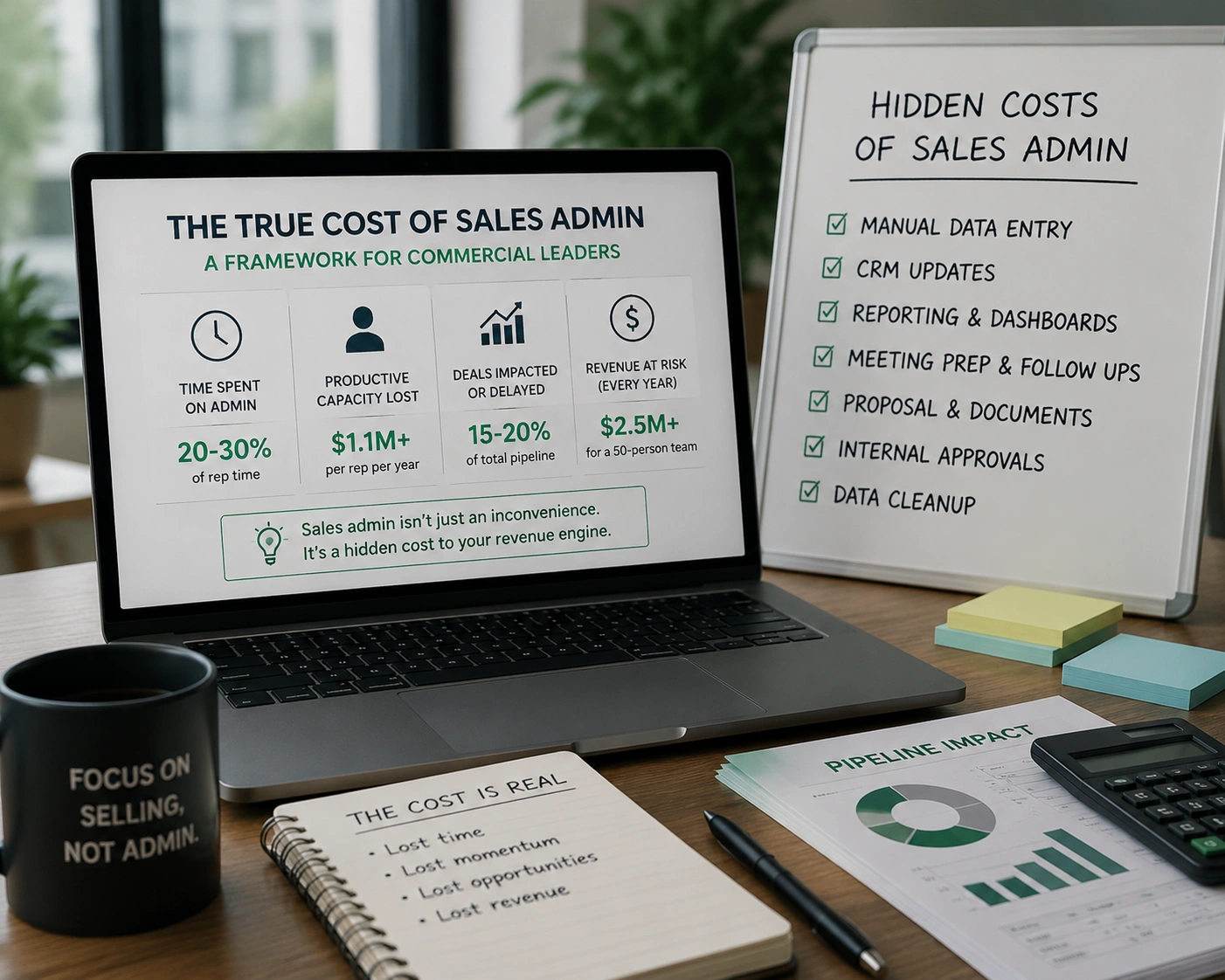
The problem with sales admin is that its cost is invisible. It doesn’t appear as a line item on the P&L. It doesn’t show up in the sales dashboard. It is absorbed into the background noise of the working week — the hours that disappear into CRM updates, email drafting, proposal production, and meeting preparation that could have been spent on actual selling.
Making this cost visible is the first step to addressing it. And making it visible requires a framework for quantification.
Step One: Measure the Time
The starting point is an honest assessment of how your reps actually spend their time. Not how they should spend it, or how the job description says they spend it — but how they actually spend it, in practice, across a typical week.
The most reliable way to do this is a time audit: ask reps to track their activities in 30-minute blocks for two weeks, categorising each block as selling time (direct prospect or customer interaction), preparation time (research, meeting prep), admin time (CRM, email, reporting), or other. The results are usually illuminating — and often alarming.
Across the commercial teams we work with, the average rep spends 35–45% of their working week on administrative tasks. For a team of 10 reps, that is the equivalent of 3.5 to 4.5 full-time employees doing work that doesn’t directly generate revenue.
Step Two: Calculate the Fully-Loaded Cost
Once you have the time data, the cost calculation is straightforward. Take the fully-loaded cost of a rep (base salary plus on-costs — typically 1.25–1.35× base) and multiply it by the proportion of time spent on admin. That is the direct cost of the admin burden.
But the direct cost understates the true cost. The more important number is the opportunity cost: what revenue could have been generated if that time had been spent selling instead?
The Opportunity Cost Calculation
To calculate the opportunity cost, you need two additional data points: the average revenue generated per selling hour (total revenue divided by total selling hours), and the reclaim rate — the proportion of admin time that could realistically be reclaimed through better processes and technology.
Multiply the reclaim rate by the admin hours, then multiply by the revenue per selling hour. That is the revenue opportunity that is currently being left on the table.
- Fully-loaded rep cost × admin time proportion = direct cost of admin
- Admin hours × reclaim rate × revenue per selling hour = revenue opportunity
- Sum across the team to get the total organisational impact
- Compare against the cost of solutions to calculate ROI
Step Three: Identify the Highest-Value Interventions
Not all admin is equally addressable. Some tasks cannot be eliminated. Others can be dramatically reduced with the right tools and processes.
The highest-value interventions tend to be in the areas where admin time is highest and where the technology for automation is most mature: CRM data entry, proposal production, meeting preparation and follow-up, and contract administration. These are the areas where AI-powered tools can deliver the most significant time savings — and where the ROI calculation is most compelling.
Making the Business Case
Armed with the quantified cost and the identified interventions, the business case for investment becomes straightforward. The question is not ‘can we afford to invest in reducing admin?’ It is ‘can we afford not to?’
The organisations that have done this analysis and acted on it consistently report that the ROI is among the highest of any sales investment they make. Not because the tools are cheap — but because the cost of the problem they are solving is so large, and so invisible, that almost any solution delivers a compelling return.