

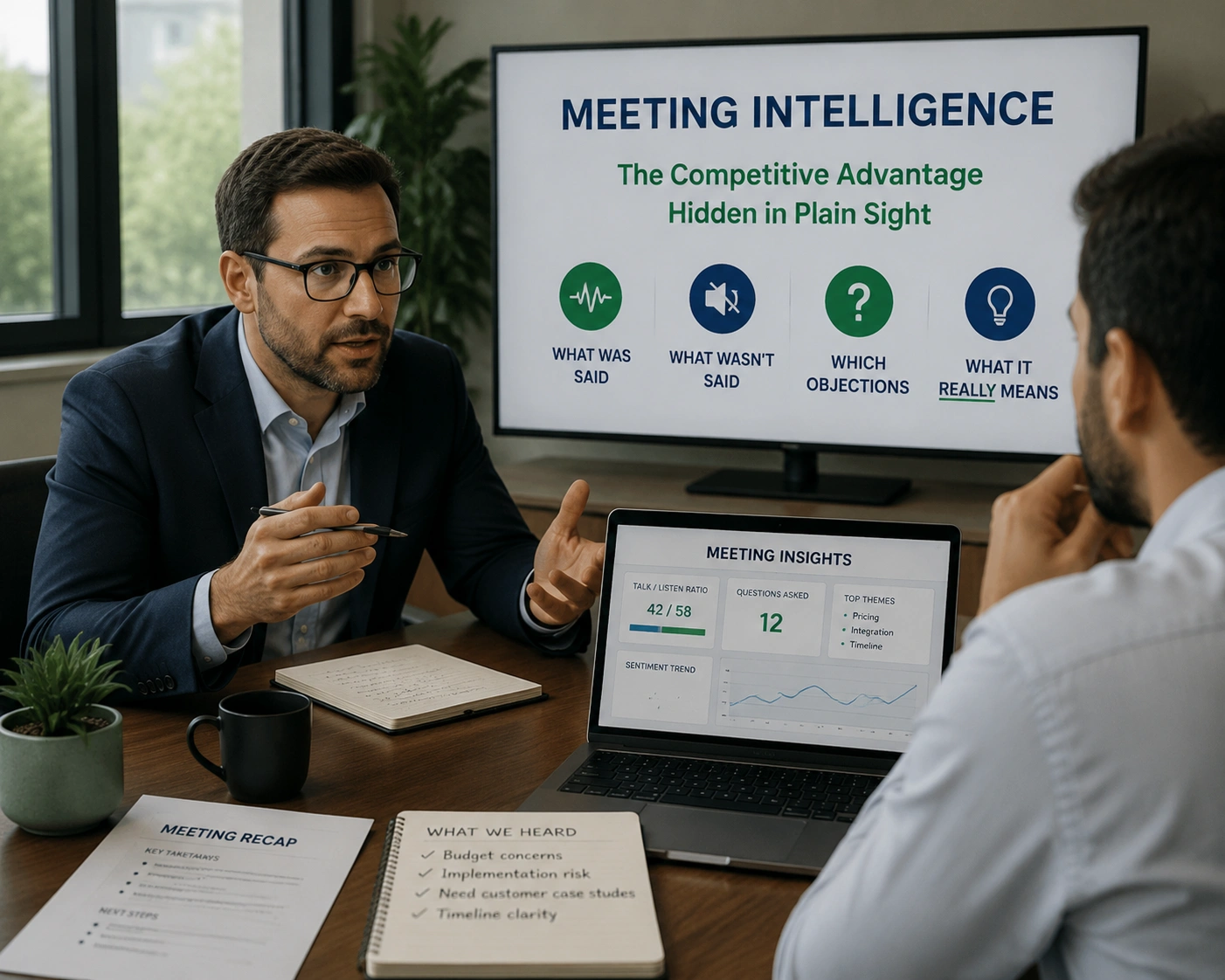
Consider what happens in a typical sales meeting. A rep spends 45 minutes with a prospect. Questions are asked and answered. Objections are raised and addressed. Commitments are made. The prospect reveals something about their internal situation — a budget constraint, a competing priority, a political dynamic — that is genuinely useful intelligence.
And then the rep leaves the meeting, writes a brief note in the CRM, and moves on to the next call. The intelligence that was generated — the nuance, the context, the signal — is largely lost.
The Signal That Gets Lost
Sales meetings are extraordinarily information-rich environments. But the information they contain is not the kind that fits neatly into CRM fields. It is qualitative, contextual, and often implicit.
The prospect who asks the same question twice — once at the start of the meeting and once at the end — is telling you something. The stakeholder who goes quiet when pricing is mentioned is telling you something. The champion who is enthusiastic in the meeting but vague about next steps is telling you something. These signals are visible to an experienced rep in the room. But they are almost never captured, and they are almost never available to the next person who engages with that prospect.
What Meeting Intelligence Actually Means
Meeting intelligence is not just transcription. Transcription captures what was said. Meeting intelligence captures what it means — and what to do about it.
A meeting intelligence system should be able to identify the key themes of a conversation, surface the objections that were raised and how they were handled, flag the commitments that were made and by whom, and highlight the signals that indicate where the deal stands and what the next move should be.
It should also connect the intelligence from individual meetings to the broader pattern of the sales cycle — so that a rep can see, at a glance, how the conversation has evolved, what has been covered, and what still needs to be addressed.
The Preparation Dimension
Meeting intelligence is not just about what happens after a meeting. It is equally valuable before one.
A rep who has access to a comprehensive intelligence briefing before a meeting — the history of previous conversations, the objections that have been raised, the commitments that were made and whether they were kept, the stakeholders who have been involved and what their positions are — walks into that meeting with a significant advantage.
They can pick up exactly where the last conversation left off. They can demonstrate that they have been listening — not just in the last meeting, but across the entire relationship. They can anticipate the objections that are likely to come up and prepare responses. They can focus their attention on moving the deal forward rather than on reconstructing the context.
The Institutional Dimension
There is a third dimension to meeting intelligence that is often overlooked: its value as institutional knowledge.
When meeting intelligence is captured systematically, it becomes a resource that extends beyond the individual rep. Patterns emerge. The objections that come up most frequently in a particular industry. The questions that signal genuine buying intent. The stakeholder dynamics that tend to predict deal success or failure. This is the kind of intelligence that makes an entire commercial team smarter — not just the rep who was in the room.
- Capture the full context of every meeting, not just the headline outcome
- Surface buying signals and objection patterns automatically
- Use pre-meeting briefings to ensure reps arrive fully prepared
- Connect individual meeting intelligence to the broader sales cycle
- Aggregate meeting intelligence across the team to identify patterns and best practices
Meeting intelligence is one of the most underutilised capabilities in commercial selling — not because the technology doesn’t exist, but because most organisations haven’t built the systems to capture and deploy it consistently. The ones that do will have a compounding advantage that is very difficult for competitors to replicate.