

There is a particular frustration that every sales leader knows. The deal is done — in every meaningful sense. The prospect has said yes. The commercial terms are agreed. The champion is enthusiastic. And then the process of actually closing it begins, and everything slows down.
Contracts go into legal review and don’t come out for two weeks. Redlines arrive that require another round of negotiation. Signatures are requested and not returned. Onboarding documentation needs to be prepared, and no one has started. What should be the final sprint of the sales process becomes a slow, grinding slog.
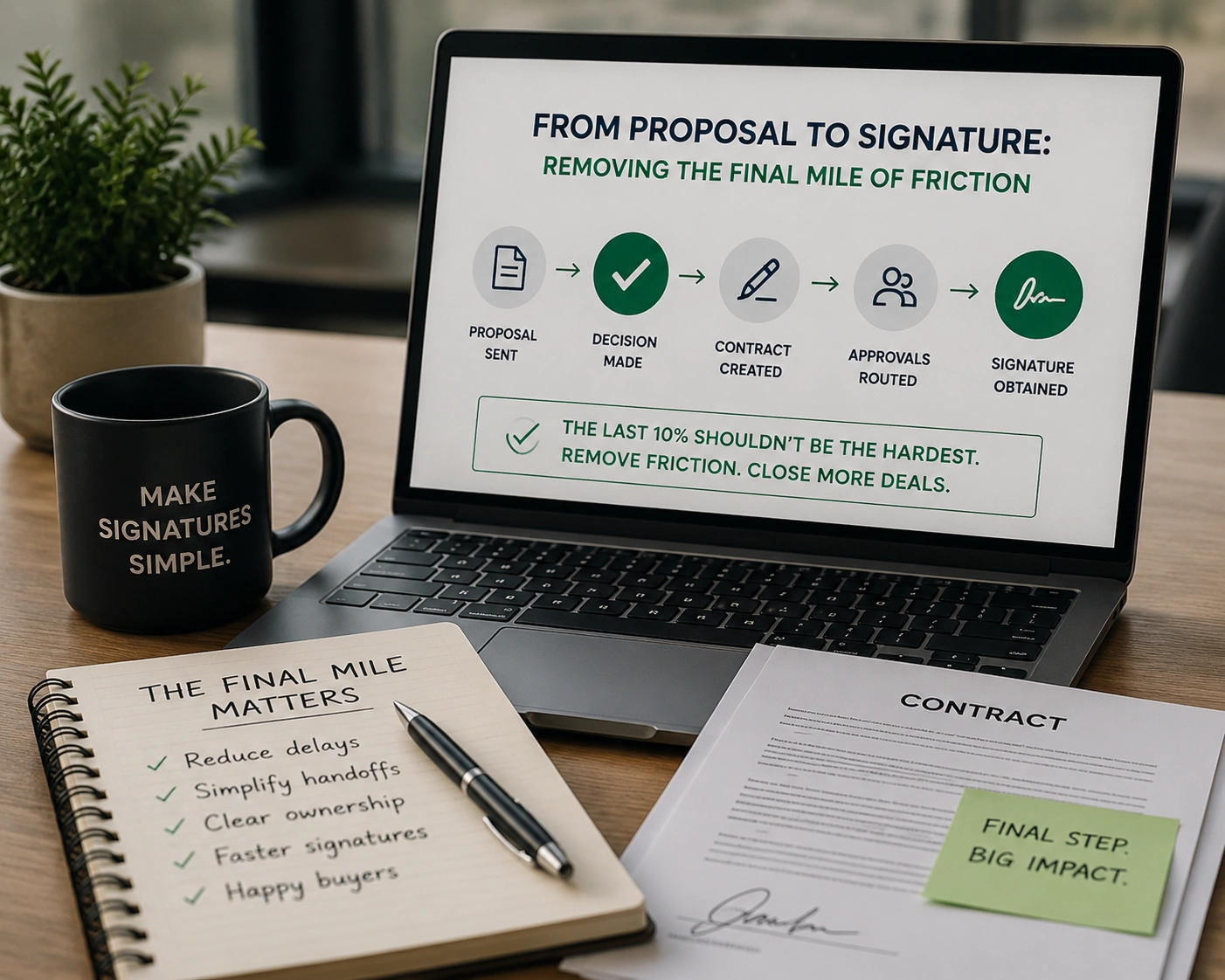
Why the Final Mile Is So Slow
The friction in the final mile of a deal has several distinct causes, and addressing it effectively requires understanding each of them.
The Handoff Problem
In many organisations, the contract and onboarding process involves a handoff from sales to legal, finance, or operations. Each handoff introduces delay — not because the receiving team is slow, but because the deal enters a queue that is managed on different priorities and timelines than the sales process.
The sales rep who has been managing the relationship for months suddenly has limited visibility into what is happening with the contract. The prospect, who was expecting a smooth close, finds themselves waiting for responses from people they’ve never met.
The Template Problem
Many organisations do not have well-maintained contract templates. Each deal requires a new document to be drafted or an old one to be heavily modified. This takes time — and it introduces inconsistency, as different reps or legal team members make different decisions about how to handle standard clauses.
The Approval Problem
Commercial terms that fall outside standard parameters require approval — from finance, from legal, from senior leadership. The approval process is often manual: an email chain, a meeting request, a wait for a response. Each approval adds days to the process.
In our analysis of deal timelines, the average time from proposal acceptance to contract signature is 18 days. Of that, fewer than 3 days involve active negotiation. The remaining 15 days are waiting time — for reviews, approvals, and signatures.
The Relationship Cost
The cost of final-mile friction is not just time. It is also relationship quality. Every day that passes between a prospect saying yes and the contract being signed is a day during which their enthusiasm can cool, their circumstances can change, and their confidence in the organisation they are about to do business with can erode.
The prospect who was excited about the partnership on the day they agreed terms may be frustrated and ambivalent three weeks later, having spent that time chasing for a contract that still isn’t ready. That frustration colours the beginning of the customer relationship — and can set the tone for everything that follows.
A Practical Framework for Improvement
Reducing final-mile friction requires intervention at each of the three problem areas.
- Maintain a library of pre-approved contract templates for standard deal structures, so drafting is a matter of selection and customisation rather than creation
- Build approval workflows that are digital and asynchronous, so approvals can happen in hours rather than days
- Keep the sales rep informed and involved throughout the contract process, so they can manage the prospect relationship during the wait
- Prepare onboarding documentation in parallel with the contract process, not after it
- Set clear SLAs for each stage of the contract process and hold teams accountable to them
- Use automated reminders and escalation triggers to prevent deals from sitting in queues unnoticed
The Compounding Effect
The improvements from reducing final-mile friction compound in ways that are easy to underestimate. Faster closes mean more deals per quarter. Better prospect experiences at the close mean better customer relationships from day one. Reduced time in the contract process means sales reps can move on to the next deal sooner.
For a team of ten reps closing 20 deals per quarter, reducing average close time from 18 days to 8 days frees up 200 rep-days per quarter — the equivalent of adding a full-time rep to the team. That is the scale of the opportunity that is currently being left on the table in most commercial organizations.
“The final mile of a deal is not a legal or administrative problem. It is a commercial problem — and it deserves the same level of attention and investment as any other part of the sales process.”